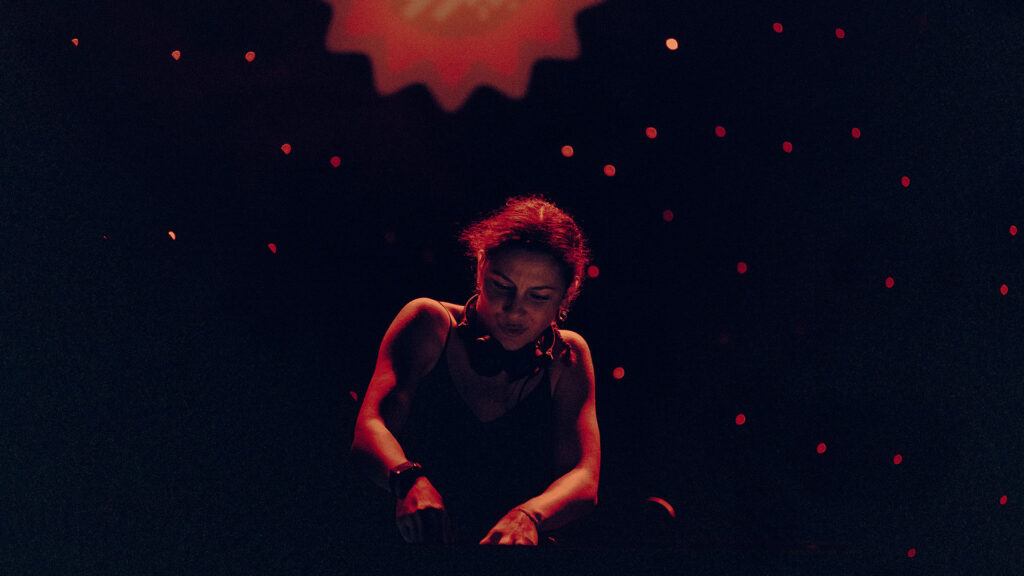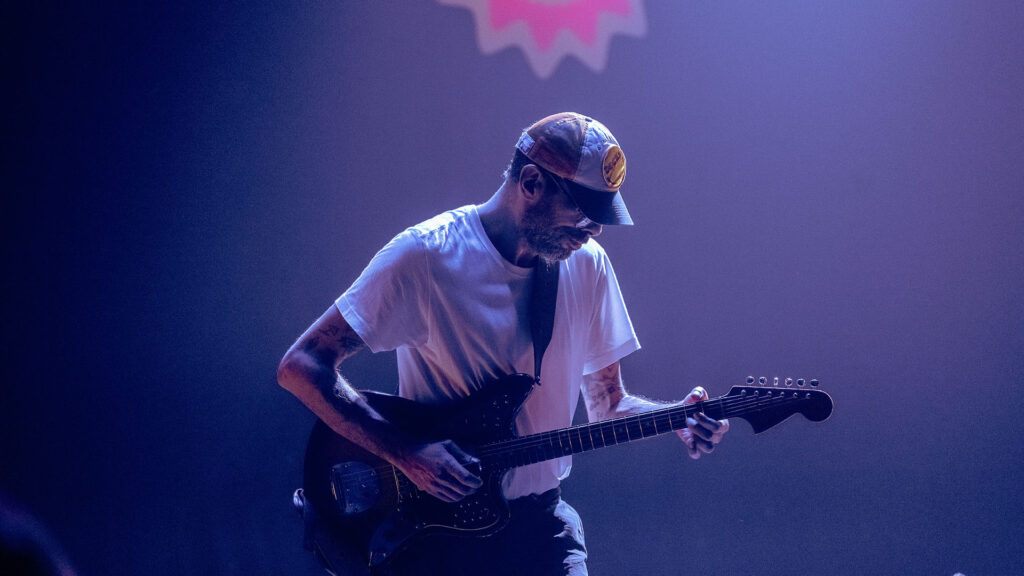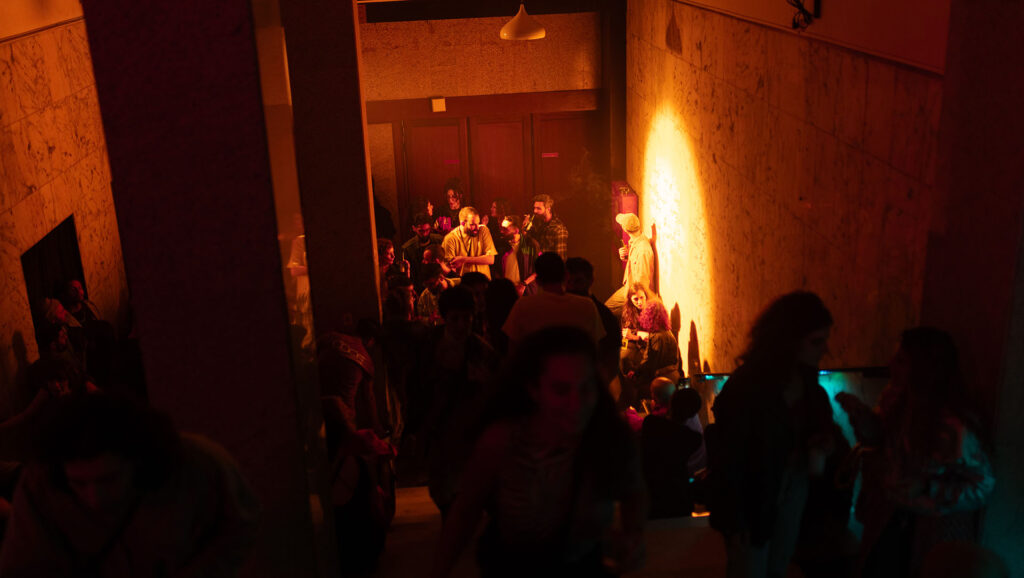

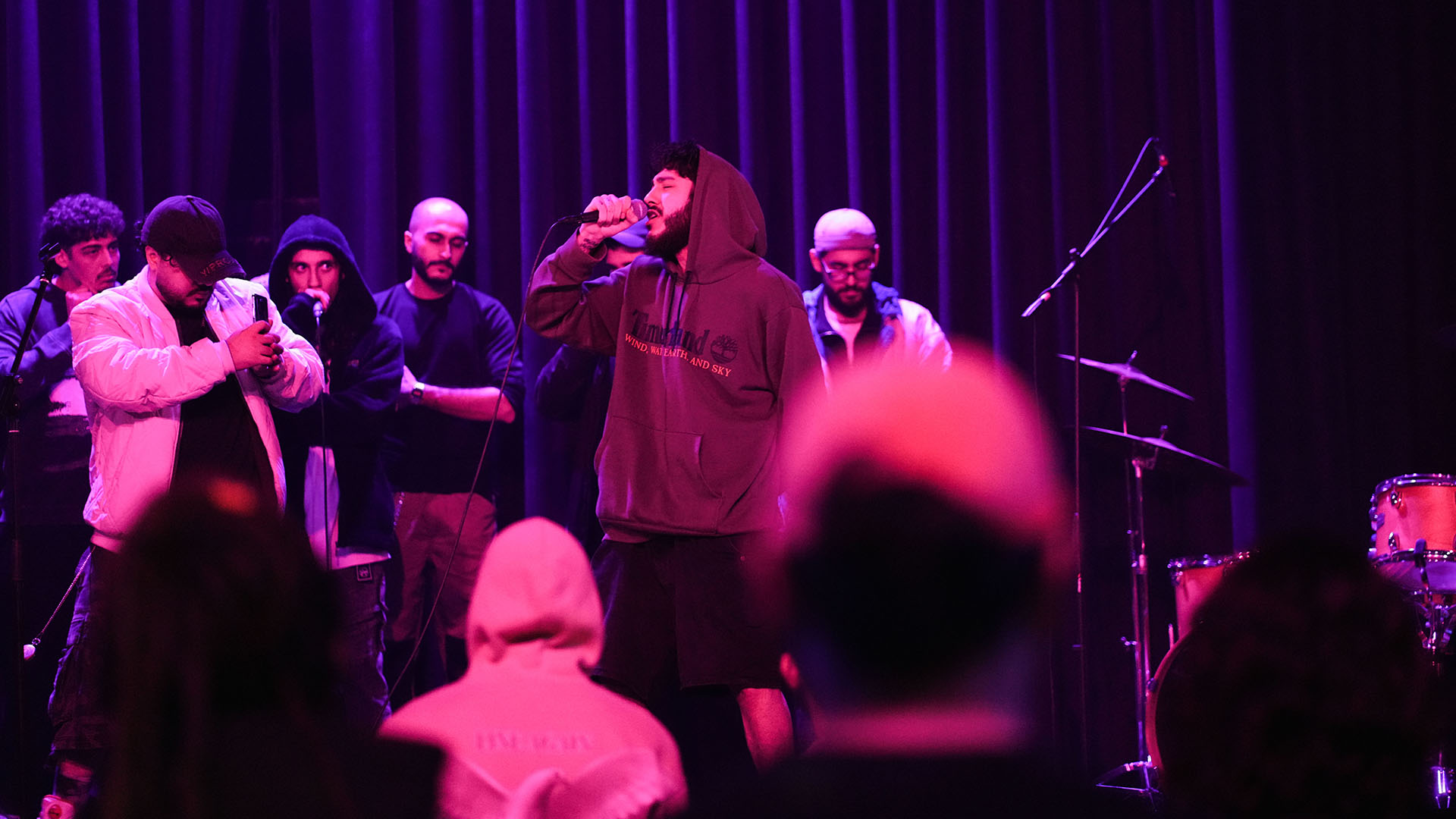
In December 2025, Beirut and Beyond International Music Festival partnered with Rumman Tripoli to bring a group of music industry professionals from Beirut to Tripoli, as part of its programming for the long-awaited 2025 edition. A busload of enthusiastic and curious music professionals from across the world rocked up to the coastal Lebanese city, eager to hear the musical offering the city had to share. Artists and professionals attending the programme walked through the cobbled streets and made their way to the iconic, yet hidden “Stereo Kawalis” for a one-off hip hop open mic night. Nestled amidst buildings and stones housing history from over three millennia, of Phoenician, Persian, Roman, Crusader, and Ottoman civilizations, the space was, for a night, a stage for the local, budding lyrical masters of the stellar rap and hip-hop scene. Majd Shidiac writes a telling account of that night and the tumultuous storylines around it in this scene report.
—
When the room filled, and people settled across the tables and bar, Rumman Tripoli director Mohammad Tanir welcomed everyone to the space. The venue, now known as “Stereo Kawalis,” was once an Art Deco cinema in the coastal city of Tripoli. A historical center to all, Tripoli remains outgripped by political greed and economic oppression, yet the presence of the likes of Tannir and his Rumman team ensures a continuity of collective cultural creation.
“It was just exciting to see everyone from the scene whom I usually catch in Beirut up here, so I’m like, welcome to my city,” says Bilel, one of the youngest rappers on stage that night. Born and raised in Tripoli, Bilel Dannawi, aka Bilel draws inspiration from the SoundCloud trap generation, with a hint of Egyptian shaabi rap influences. During an hour-long conversation with Bilel, reflecting on the open mic and his relationship with the rap scene, he was never shy about showing the complexity of coming from a place you love, yet one that obstructs you.
“I hadn’t met Ghanim before, but he came to our table before the show and asked if we were all MCs, and we said yes. So he said, you can rap to any beat, right? And we also replied yes.” Bilel recounts his first interactions with the rap scene’s up-and-coming silvertooth kid Ghanim, aka Adam Ghanim, who is also the co-founder of Gaza’s Manjam Records. A powerful musical instigator and lyrical agitator, he had performed at the festival earlier in Beirut and came with the music professionals with a hard drive full of beats and a heart even fuller with unchallenged passion for the game.
The space was brimming with those great human feelings of curiosity and doubt that reside in anticipation of improvised showcases. Raising these questions that push us to the edge of the seat, such as “Is this actually going to work out?” Breaking the inertia with initiative, Alexandrian (Egypt) native Rasha Sha’ban played into the fundamental element of agency in the circle of the dance, playing a lively Mahragant selection through her phone, simple but effective.
The evolution of Mahraganat into Arabic hip hop and EDM has been exciting, especially as it showcases how this historically accessible genre has always carried such potential for innovation. But for our open mic night, which hasn’t started yet, it was Shaabi’s entrancing, visceral, and almost immediate effect on getting people dancing that provided a budding communal floor.
The spaces between the tables and the stage seemed to shrink as the crowd galvanized. And just when the synthesized melodies brought everyone to the sweet spot, Ghanim wasted no time in taking the stage in his signature hip hop stride to challenge all MCs. “My name is Adam Ghanim, it’s my first time in Tripoli, and I heard you got some bars,” he said before digging into his beat library from a hard drive that seemed to be hanging by a thread.
The Beginnings… Filling in the Blanks
“I went back to the 2010s Radio Beirut mentality, like yo! I’m gonna snatch the mic, and I’m gonna kill everyone on stage. It was nice, it was very reminiscent of that time, because we all killed it- it didn’t stop. This felt like home to me; this is where I come from, my origin story.” This was one of the very first reflections for Jamul, aka Mohammad Jamul, about the night. A Beirut-based true Hip Hop head, Jamul leans into the intersection of boom bap and experimental rap, having one of the richest release libraries among the performers of that night.
It was the first time I saw Jamul perform. His name often came up in conversations I had with friends some years back when discussing the new-age rap scene in Beirut. For us, Arabic rap was always underground. But particularly in Lebanon, the sonic history seems somewhat patchy. We can’t entirely trace the sequence between rap groups like Aks’Ser and Erhab Records in the 90s and early 2000s, who showed entirely different reactions to post-war Lebanon’s alluring temptations and flagrant promises, and artists like El Rass, Bu Nasser Touffar, Jaafar Touffar, Chyno with a Why? (previously known as Chyno), and Ed Abbas, in the 2010s, who battled with new truths amidst an uncertain “Arab Spring”. And until recently, we couldn’t pinpoint what or who came after either. “That’s what makes it competitive, someone is going to outshine the other, and if you choke, we don’t just stand and clap for you, someone is snatching the mic and spitting,” Jamul tells me about his foundational years as a regular at the city’s weekly hip hop open mic night at ‘Radio Beirut’. The night, which presented itself under many names and editions, including “Hip Hop Essentials” on Mondays and “تمارين المساء”/ (Evening Exercises) on Wednesdays, was a weekly get-together for the hip hop scene and a platform on which many, including Jamul, discovered their game.
Back then, what drove Jamul, he says, was the opportunity to stand on stage with legendary rappers like the late Double A the Preacher Man (Hussein Charafeddine); a pioneering figure in the Lebanese Hip Hop scene. Hailing from Saida, Lebanon, he was widely known for his high-energy freestyles and served as a beloved MC, host, and frontman for the funk-blues band The Banana Cognacs) or Jeff the Prophet who was a notable underground rapper and artist in the Lebanese hip-hop scene. He was affiliated with the Beirut Records label and gained recognition in the local rap circuit around 2019 and 2020 alongside other acts like Kalach. Jamul wanted to be seen as a peer, or perhaps at least as a competitor. Knowing that in order to earn his slot, he had to write new bars every week, challenging his lyricism and musicality.
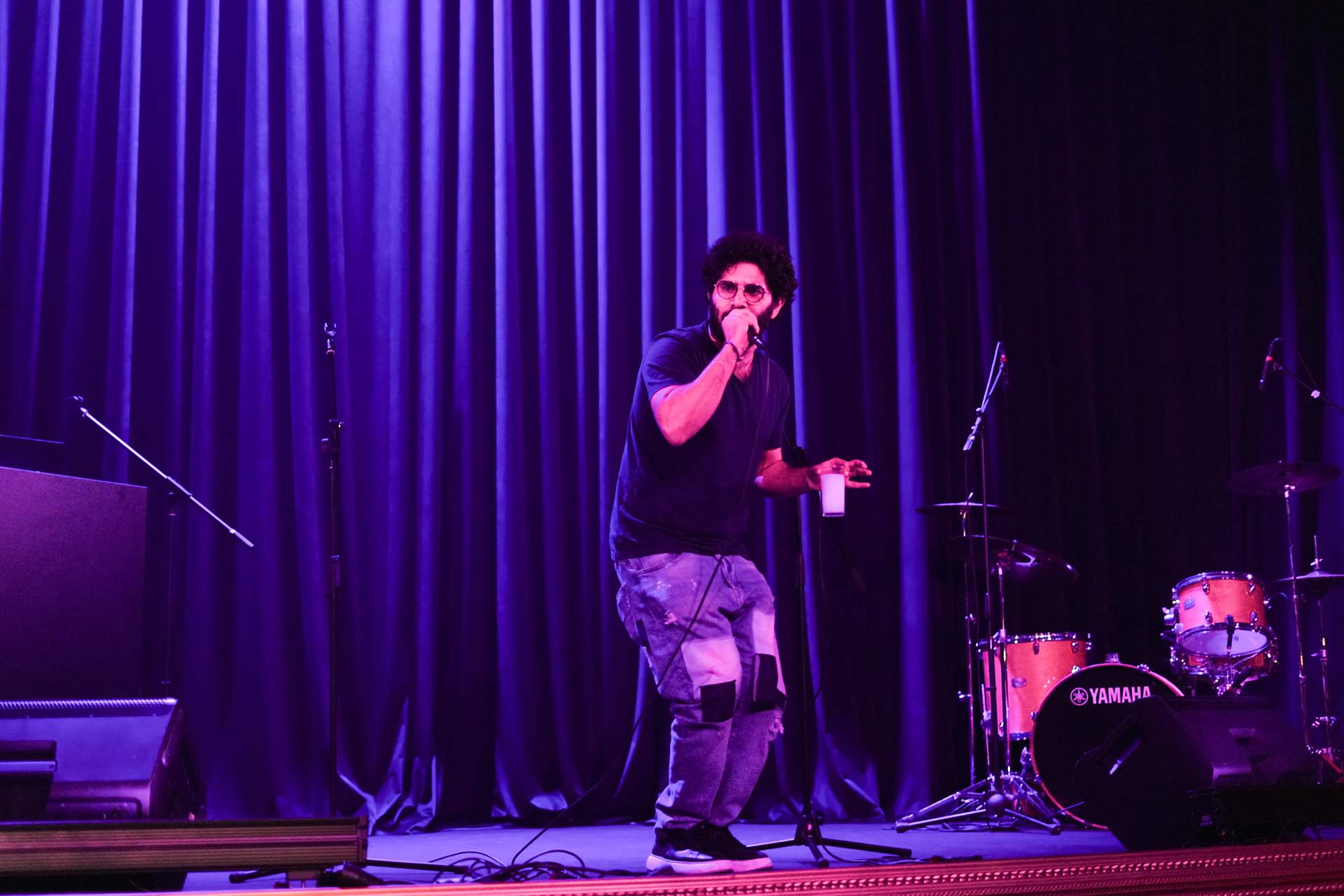
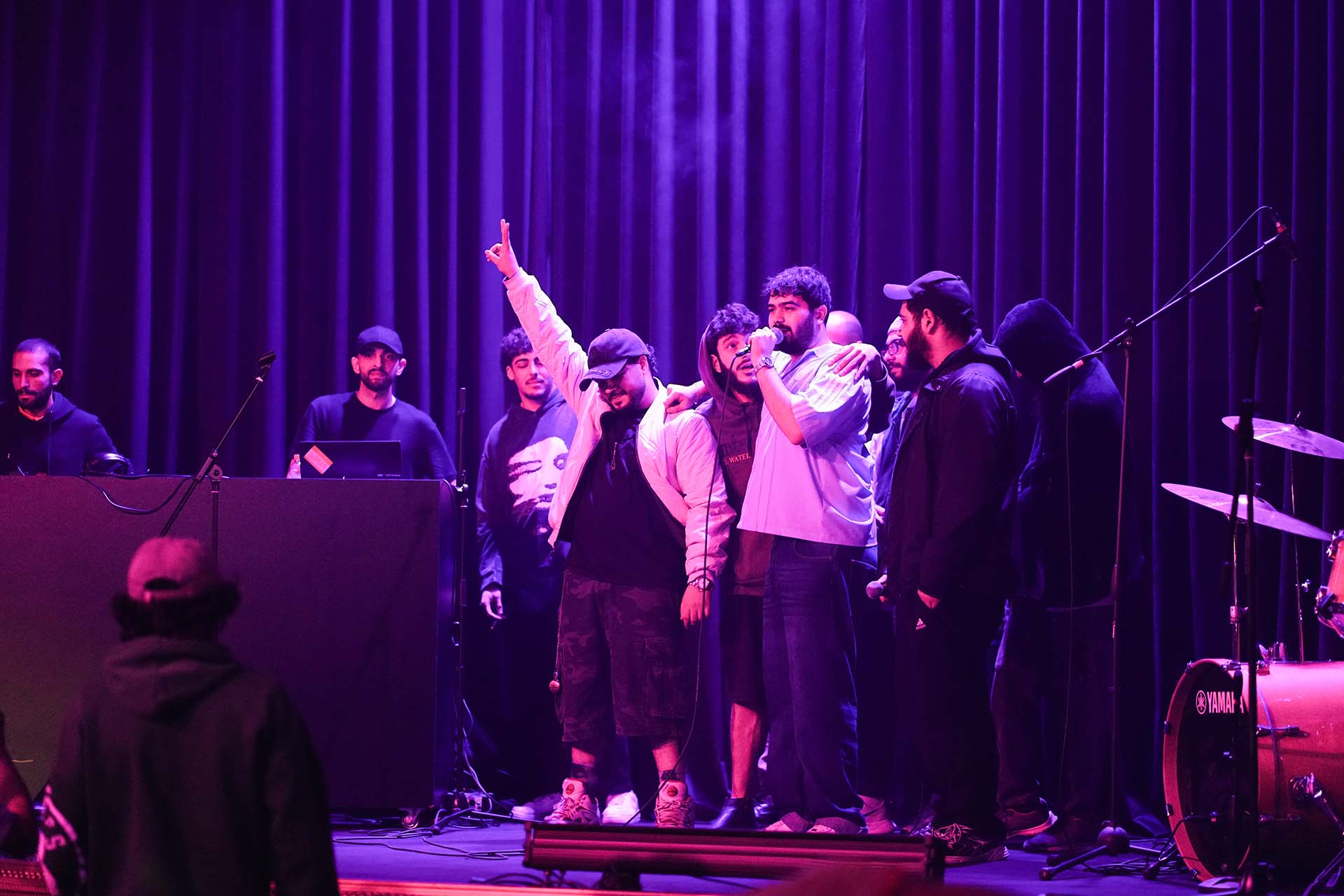
That night in Stereo Kawalis, it is precisely that energy and level of mastery that he portrayed again, alternating between loosely structured flows and almost militant precision, without so much as a drop spilling from the drink he held throughout the performance. And it is that shine he spoke of, that I assume gripped all the MCs who rushed the stage at once. Two shaky, auto-tuned mics were instantly being passed around a group of hungry MCs, and the setting quickly turned into a Cypher: rappers taking turns to freestyle over a wide range of beats, an exhibition of their skill and unique style.
The sudden presence of some 12-15 rappers, producers, and collaborators on stage, including Nuj, Douwwar, HADI, Jamul, Bilel, Aladhamy, WZA, Ghanim, Wa3ri, Kays and later on, graced by the melancholic voice ayahausca_was pleasantly overwhelming. Maybe not as much for the technicians who rushed to live EQ a capricious range of flows, treating one cadence after the other. And at times when Ghanim’s hard drive would give out, or the generator stalled, the verses would turn acappella, or live drums would replace the beats in defiance, somewhat symbolically, of structural and regional challenges insisting that the show must go on. The cypher that no one expected lasted for more than an hour without a single pause.
In Between Crises… On Finding Means to Voice
“This feeling of non-belonging is real for everyone, not just me. This estrangement doesn’t come and go; it’s a constant state that you’re in, maybe generally as an Arab, with the influx of cultures. It’s natural to react, and this reaction embodies itself in the symptom of non-belonging.” HADI, aka Doctororgans, aka Hadi Mroueh is surrounded by a pensive air as he reflects on his rap journey. Hailing from Ain Ebel in the South of Lebanon HADI is a rapper, producer and artist par excellence. With bass-heavy productions and image-filled lyricism HADI’s work is staring into the void in the middle of small talk.
During the period between 2014 and 2019, hip hop nights were as much a hub as Beirut was a relatively safe, albeit uncomfortable haven for rappers and producers maneuvering the multitude of wars and crises in the region, including the war in Syria. This movement of our people was, in a way, transformative to Lebanese hip hop. Not only because we got the chance to watch and engage with Arabic hip hop pioneers like The Synaptik, Aldarwish, Mehrak, Assaasi, Jundi Majhul to name a few, but also because, during this time, these artists were building lyrics and rhymes together. This had an exponential impact on their growth as they shared resources, exchanged methods, launched rap collectives, and pushed each other.
Perhaps the most imposing loss that came about with the closing of the hip hop open mic nights, and the many spaces and movements that fell victim to the country’s devastating decline, and encircling imperial aggression, was the sense of community specifically when practiced in a physical space.
The conducive groundwork that resulted from the enmeshing of stories and sonic identities that traveled from the Yarmouk refugee camp all the way to the sun-baked fields of Baalbeq to unravel in one erratic monologue of a city like Beirut, helped uncover Arabic rap from the guise of another form of westernization, and brought it closer to its origin. This conviction seems to be crystallizing further with the new generations, as HADI puts it, “I believe Arabic rap is built differently, but we need to give credit where credit is due. Especially, neglecting the origins of Arabic rap by taking it outside of its universal context is not only unjust, but rather carries a form of racism towards the originators. Rap is a reaction to global imperialism, and Arabic rap is that as well, and I think that’s the natural extension of rap and hip hop anywhere in the world.”
There’s an amalgamation of probable reasons why Beirut was, during that time, and to some extent still is today, the contemporary cultural hub of the country. Be it the lack of spaces and the material conditions that can sustain them across Lebanon, the concentration of investment in city-based projects by local and foreign investors, or the relatively inclusive role that Beirut has played within the wider historical context. Knowing this gives spaces like “Stereo Kawalis” (amongst a few other performance and residency spaces that have recently emerged across the country) and the open mic night an exciting dimension of possibility. Breaking out of the city uncovers the nuanced insight that gets lost in the urban noise.
For instance, our artists find themselves having to take the journey to Beirut from the South, in the case of HADI, and North, in the case of Bilel, to partake in the scenes and communities they are part of. This journey often questions their positionalities as cultural practitioners but also as individuals. “I talk about it a lot in my upcoming album, the identity crisis I had the first time I came to Beirut. I remember the first time I went there, I was acting too kind, just to show like I’m not the violent Tripoli type, you know what I’m saying?”,says Bilel.
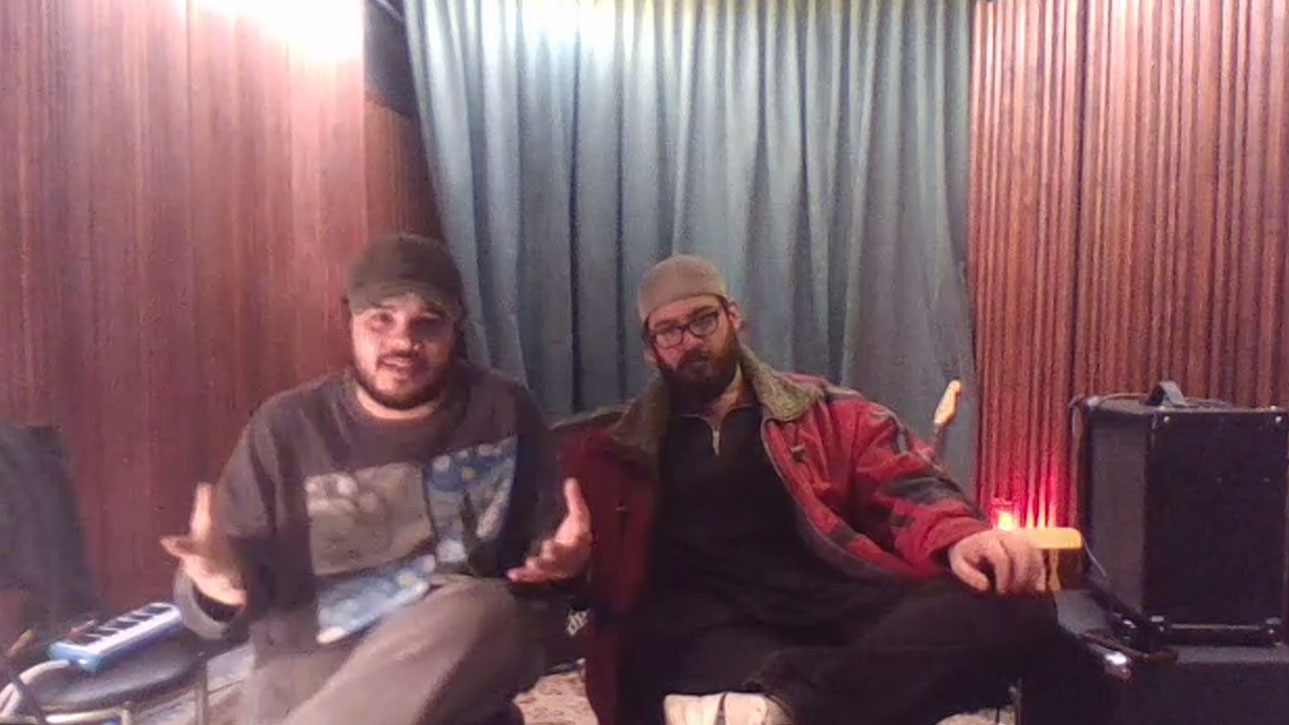
Bilel and Aladhamy on Zoom, from the recording studio in Stereo Kawalis
Getting out of Tripoli seems to have been vital for Bilel’s growth artistically, but also in his music career. Although Tripoli is the home of Arabic rap legend Mazen El Sayyed, aka El Rass, the lack of proper infrastructure, from spaces to record and perform to talent and funding, has made the continuation of this legacy less intentional and broadly based on personal endeavors – but at least, we see some unprecedented movement of Tripoli-based hip hop artists like Bilel, Douwwar, Aladhamy, and WZA taking shape.
But what challenges Bilel in his view is a clash with, or a contradiction of, his surroundings. Increased gun violence makes it hard to focus, while the disarray around seeking a career in art, and the community struggling to put food on the table, deem the journey detrimental from the get-go. And between the reserved perception of bleak prospects for the youth in Tripoli, and the stereotypical gaze of Beirut lies a journey that Bilel takes daily. One that, unironically, brings him closer to where he comes from, embodied in a special connection he shares with his producer and collaborator Aladhamy. “I bridged that part of me being a rapper and me being the guy from Tripoli because of Adhamy. During that period, I was working with producers from Beirut, and we were making good music. But I was on this introspective journey at the same time, trying to make music that I really find myself in. So when I met Adhamy, someone who grew up in the same environment as I did – literally (we’re from the same neighborhood) and have lived similar experiences, I started finding myself more musically.”
Seeing all the performers on the same stage was a triumphant moment, albeit a somewhat bitter one, with the multitude of struggles these artists carry and the survivalistic need to overcome them; and they do overcome them, flamboyantly. In the aggressions of 2024, as in this one, HADI is forced to leave his home, and consequently his bedroom recording studio in the South. But even on days with a relative sense of normalcy, HADI has built his sound and craft around shifting environments, where any room can become a recording studio, and the surrounding sounds from car exhausts and sirens to children on the street find their way into HADI’s production.
HADI’s ability to carry light and adapt his creative process to changing environments is, especially today, a valuable skill. His decision to work with the exact intrusive elements as creative inputs carries a deeper undertone, “I don’t have a specific place where I create. I don’t think about it in that sense. There’s the recording and mixing part, maybe, but that requires the most minimal setup; a microphone and a computer – done. It doesn’t even have to be treated; the room not being treated serves the mood (in which it was created). I wrote the lyrics for “Al Sawt الصوت” (the Sound) in the car on the 21st of September (2024) under bombing. I wasn’t the one driving; I was sitting there, and I wasn’t going to cry, so I wrote. I didn’t have a choice; there was something I was feeling, and it had to come out somehow. I recorded it in the temporary house we stayed in during our displacement; my friend lent me a mic, we recorded it, and that was it.”
Perhaps what HADI offers through this process is a captivatingly unpolished body of work that reflects the ‘grittiness’ of daily life in constant existential limbo. And, more importantly, perhaps it is to be felt and listened to as a powerful sonic documentation that today, HADI and thousands of Southerners are having to once again take that dangerous journey to the unknown to flee systematic targeting and savage settler expansionist ‘aspirations’.
Maybe that’s an immense pressure to put on young rappers, to defy the crumbling space, to plant verse where presence is persecuted, to resist by persevering alone, and transcend by finding the other. And maybe this is what truly connects our rappers who cross this path, hailing from our exploited lands and betrayed communities.
What now?… Beirut and Beyond, A Hip Hop Legacy:
Despite the tightening circle of western aggression that continues to ravage our lands and cut, both figuratively and literally, any roots that took years and decades to nurture, we’re witnessing global breakthroughs for the Lebanese rap scene, with rap groups like ‘M7dh0n’ releasing what has verily become NTS cult favorites, or the newly launched ‘Milq Records’ currently touring with new and familiar faces like Boumph!, El Rass, and The Synpatik.
In this regard, the hip hop open mic night shined a spectacular and much-needed spotlight on our up-and-coming artists who are crossing many uncharted territories to bring a new dimension to Arabic rap. The more I think about it, the more I see them as being driven by purpose. Because how else can anyone create and innovate despite economic collapse, political instability, and continuous threats to safety and wars of aggression if not driven by a relentless truth? In this pursuit, these artists are finding new language and new tools to shape it sonically, they’re amassing influences from both old and new hip hop generations while producing a sound undoubtedly unique. And whether they have found their footing or not yet, each of these artists is filling a plethora of gaps, having to build and partake in the industry at once, and going at lengths to do so. Imagine standing on a plank you’re just nailing to the board.
A spotlight indeed, and rightfully earned especially with the presence of established artists and record labels from across the Arabic-speaking world and internationally in the crowd. “Before the money and everything, it’s about recognition. And recognition is literally that, you either exist or you don’t,” as Jamul puts it clearly. And perhaps the fact that these young rappers were able to put on such a skillfully gripping and entertaining show, spontaneously, off the cuff, should earn them a slot in the festival’s main programming in the next editions, carving the future of Arabic rap from the ruptures of the Lebanese music scene.