

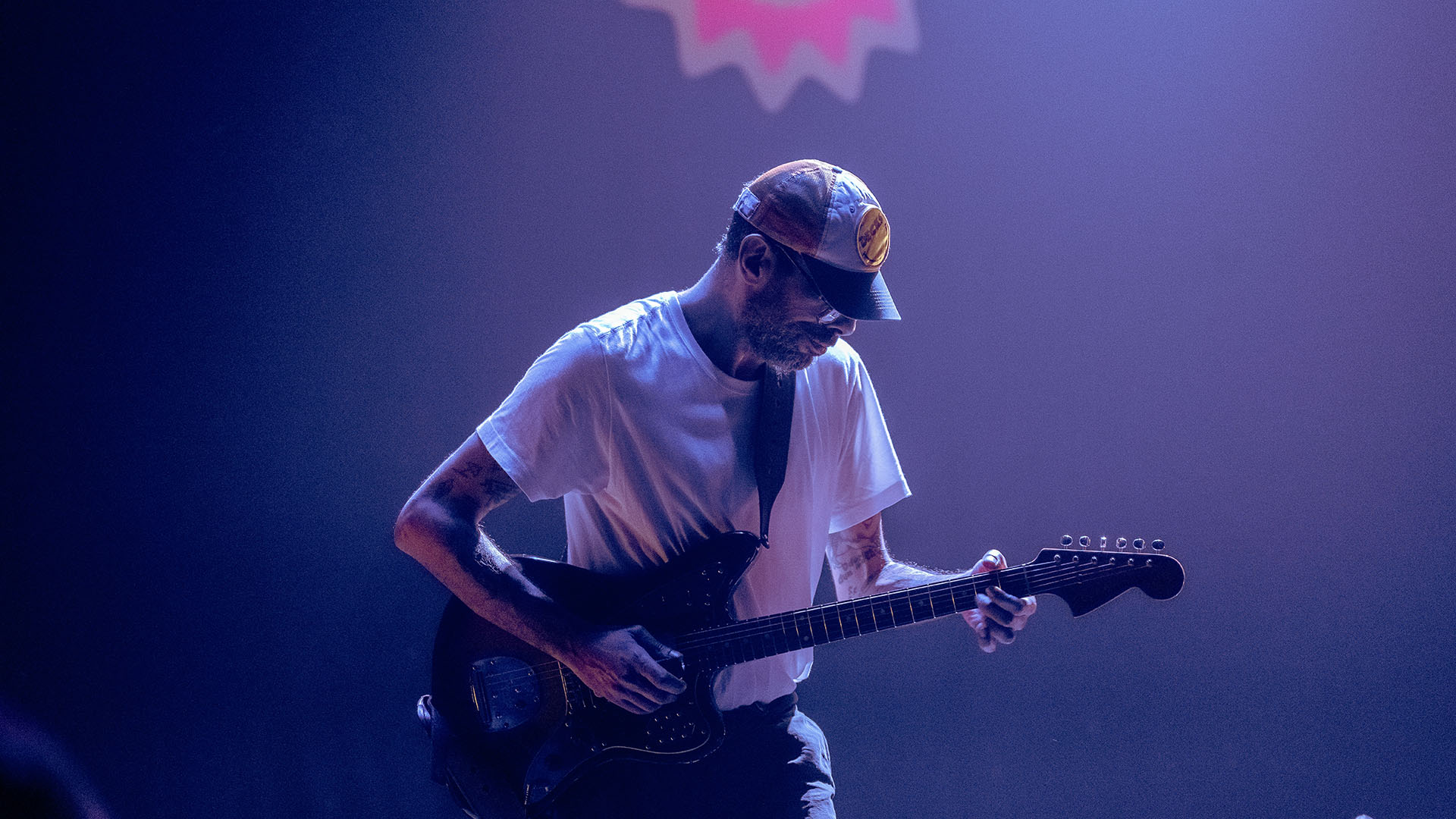
As a superstitious person, Charbel Haber still knocks on wood, avoids walking under ladders, and gives his ultimate exception to the felines which he was feeding before the interview. His phone lights up, and his screensaver is what you expect, a furry face that has accompanied Haber for years, his cat Bernard.
Haber’s titles do not end there; he is a musician, a composer, sound designer, visual artist, DJ, and poet/author. His book, A Common Misunderstanding of the Speed of Light, or, as he refers to it, the orange book, was released in 2022. As a multi-media book, “the orange book” contains photography, poetry, and music. However, Haber does not call himself a writer.
You will also find Haber’s name in the end credits of films where he has composed for numerous projects such as Sleep, The Last Man, Diaporama, Le Liban en Automne, Beyrouth Hotel, and many more. But for Haber to compose the soundtrack, he has to “REALLY” like the film. And when he likes the film, he spoke on how motivation is easier to find when writing for film rather than writing solo work.
“Making a record is more difficult; you have to motivate yourself unless you are working with a group. When you are working solo, you do not know where to start, what you want to talk about,” he said. “Especially for people like me whose works are very abstract; I sometimes write love songs, but not when I compose instrumental pieces without vocals. They give you a lot of information about the general direction of the work. When it comes to abstract material, it is more difficult, but very rewarding when it works out in the end.”
On Haber’s Collaborative Album with Nicolas Jaar and Sary Moussa
Haber’s works are often recognizable as soon as you read an obscure, slightly nihilistic, yet highly amusing title. Whether his solo-work, albums, records, or bands, the linguistic humor often lets you know that you have stepped into Haber’s discography.
However, something felt different about Haber’s latest collaboration with Sary Moussa and Nicholas Jaar, “Crashing Waves Dance To The Rhythm Set By The Broadcast Journalist Revealing The Tragedies Of The Day”. The title name was there, but all the tracks on the album had no names.
“This has been happening for quite some time,” Haber explains. “I give my work titles and then I do not care. The work orbits this sentence and this title specifically. With this specific record, there is a text on Bandcamp that explains it. Titles are difficult for me now. If I had to give these pieces titles, they would come from the text. The title for the album itself came from the text.”
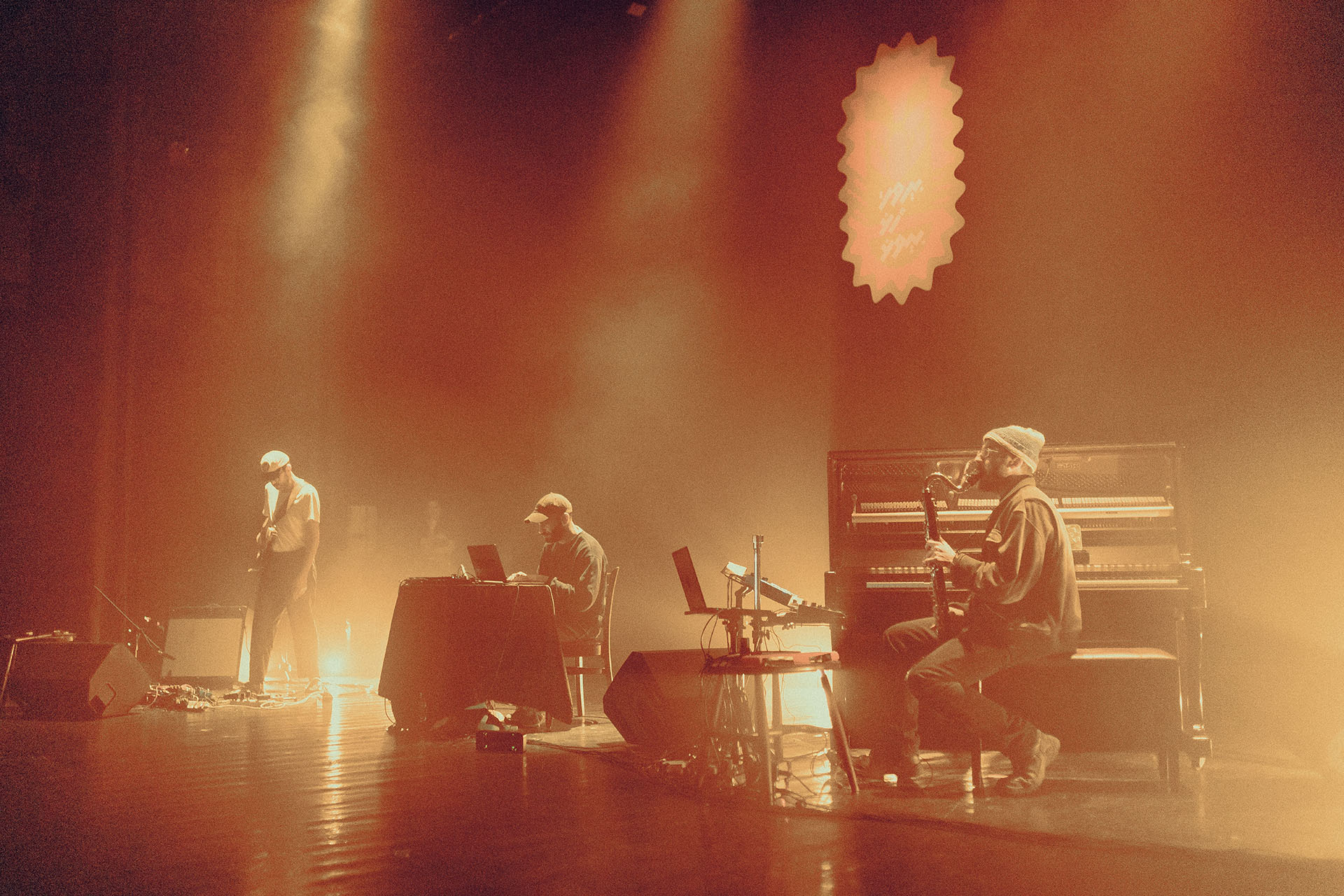
This sporadic collaboration is a happenstance of different encounters that accumulated over the last fifteen years. Haber and Jaar being fans of each other’s music and albums, with even Jaar including Haber’s track in a radio set. As for Moussa, his record “Imbalance” was released on Jaar’s label “Other People”. The trio came together at Tunefork Studios to record the improvisation album.
The darkness in the album does not come out of nowhere, as it was recorded during the aggressive bombing and escalation of the war by the Israeli Occupation on Lebanon and Gaza during the summer of 2024. Haber recalls: “Nicolas had just arrived in Beirut, and they had hit Dahye that day. We went to the studio with no idea of what we would do. We started playing, and this is what we played. No overdubs, the editing is minimal. What you hear is what is directly dictated by the current events.”
Recorded as an improvisational one-take session, with no overdubs and minimal editing, the collaborative ambient/drone album is composed of four parts, where all three artists had their distinctive sounds coming through, with Haber’s eerie, haunting, and calming guitar plays, Jaar’s bass clarinet/acoustic treatment, and Moussa’s electronic steering.
While Part 1 puts you in a dream-like state, Part 2 quickly pulls you out of it with sharp electronic bangs and drones. Part 3 continues the sharpness, yet finds a way to pull you back into a sort of serenity that can only be described as a lucid dream. Part 4 ends the album sharply and definingly, with dreamy guitar, drone, and electronic compositions, and bass clarinets crashing in your ears like ocean waves.
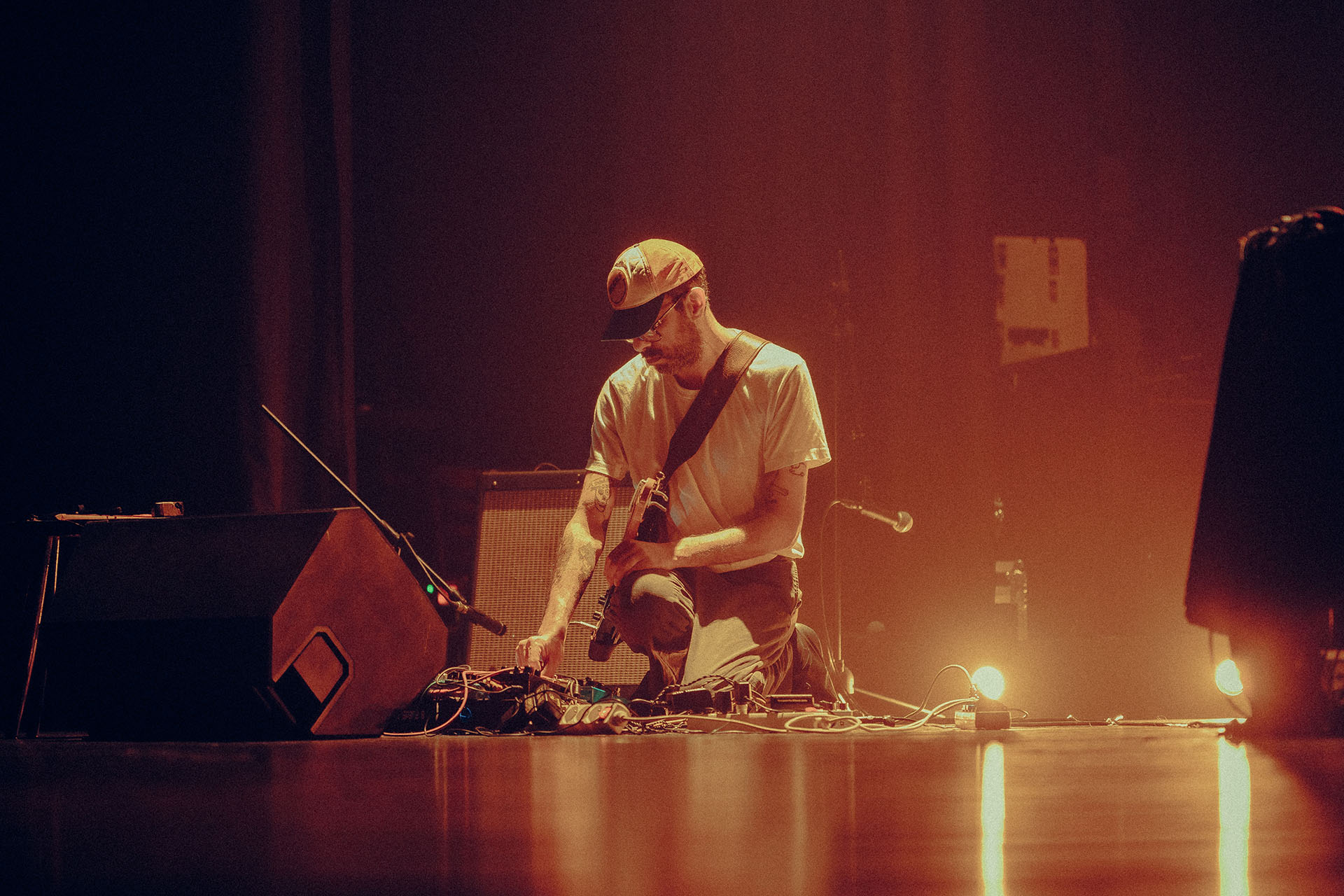
Known for his wide selection of gear, Haber masterfully designs sounds through a careful selection of sonic paraphernalia. When asked about his choice of gear to create the plethora of soundscapes he’s known for, Haber’s list was anything but short. “A Jaguar Fender guitar, and I use a bunch of pedals; my main reverb pedal is a Meris Mercury 7, I have a beat crusher by Meris called the Ottobit, I also use an Italian pedal called Ricorda, it’s granular reverb, ZVEX Lo-Fi Junky looper, MOOD by Chase Bliss, which is a weird reverb pedal, and much more, also the Blooper by Chase Bliss, Stretch Weaver by Drolo Fx, a compressor from Empress, and micro-looper delay pedal from Montreal Assembly,” he listed. Impressively, Haber not only remembered but also still keeps his first pedal till today, which is the Distortion DS1 by Boss.
Haber’s sonic crafting isn’t independent of his lyrical wit, and despite his lack of focus on titles, he pours a lot of energy into his lyrics. “My writing process is me having no discipline. I cannot call myself a writer because a writer sits down daily at their desk and writes. They write bad stuff and good stuff, but they write for hours. That is how writing happens. It flows and accumulates, and then you have something. It hasn’t been happening lately for many reasons, one of which is, that after everything that has been happening in Gaza, it’s been very difficult to write anything and to create anything that has meaning. All meaning was lost, especially in how the world has dealt with this human-made catastrophe,” Haber shares. explained.
Dealing with the heaviness of today’s world, he contributes poetry as his system of belief and the transcendence of humanity through arts and science. Habe expounds that today’s events and violence convinced him more than ever evolution forgot society through its focus on technological advancement. This couldn’t help but spark the question: is peace still overrated?
Chuckling carelessly in his laissez faire manner, Haber responds: “Totally! Peace on its own, like the idea of a peaceful world. It is not a wish; it is a process to get to peace. We are talking currently about the peace of the white man, where most of the world burns but your continent is okay, so everything is okay. Peace has to be everywhere, and for that to happen, you need economic and social justice. That is how we get to peace, which is not overrated. However, the peace that we talk about today is just a break from yet another war. It is a time-out. That peace is overrated and not real; it is a break between two wars, an interbellum.”
Amidst the violence, noise, turbulence and musical innovation, one can’t help but wonder: what is Haber listening to today? His answer is swift and simple, yet in jest: “Al Jazeera, unfortunately, not the most reliable news source, but it’s all I have abroad,”. “Music-wise, I have lately been listening to the ambient artists that I like, such as Tim Hecker and Christian Fennesz, some Sun Ra and Alice Coltrane. Going back to the things that I like. I would love to collaborate with Alice Coltrane and Pharoah Sanders one day. That would be my dream, without any hesitation.
And it is perhaps in going back to things we like, and dreams we hold, that we can move forward towards forging a more social-justice oriented world.
— Pictures by Tamara Saadé